誰がCatherine II of Russiaとデートしましたか?
Alexander Yermolov 日付の Catherine II of Russia ? から ?. まで
イヴァン・リムスキー=コルサコフ 日付の Catherine II of Russia ? から ?. まで 年齢差は 24 年 8 か月 22 日.
Alexander Dmitriev-Mamonov 日付の Catherine II of Russia ? から ?. まで 年齢差は 29 年 4 か月 28 日.
Alexander Lanskoy 日付の Catherine II of Russia ? から ?. まで 年齢差は 28 年 10 か月 6 日.
Sergei Saltykov 日付の Catherine II of Russia ? から ?. まで
Pyotr Zavadovsky 日付の Catherine II of Russia ? から ?. まで 年齢差は 9 年 8 か月 19 日.
シメオン・ゾーリッチ 日付の Catherine II of Russia ? から ?. まで
アレクサンドル・ヴァシーリチコフ 日付の Catherine II of Russia ? から ?. まで
Platon Zubov 日付の Catherine II of Russia ? から ?. まで 年齢差は 38 年 6 か月 24 日.
Gregory Potyomkin 日付の Catherine II of Russia ? から ?. まで 年齢差は 10 年 4 か月 22 日.
グリゴリー・グリゴリエヴィチ・オルロフ 日付の Catherine II of Russia ? から ?. まで 年齢差は 5 年 5 か月 15 日.
Stanisław August Poniatowski 日付の Catherine II of Russia ? から ?. まで 年齢差は 2 年 8 か月 15 日.
Catherine II of Russia

Catherine II (born Princess Sophia Augusta Frederica of Anhalt-Zerbst; 2 May 1729 – 17 November 1796), commonly known as Catherine the Great, was the Empress of Russia from 1762 to 1796. She came to power after a coup d'état against her husband, Peter III. Her long reign helped Russia thrive under a golden age during the Enlightenment. This renaissance led to the founding of many new cities, universities, and theatres, along with large-scale immigration from the rest of Europe and the recognition of Russia as one of the great powers of Europe.
After overthrowing and possibly assassinating her husband, Catherine's subsequent rule of the Russian Empire often maintained close alliances with noble favourites such as Count Grigory Orlov and Grigory Potemkin. She appointed and worked with several highly successful generals such as Alexander Suvorov and Pyotr Rumyantsev and admirals such as Samuel Greig and Fyodor Ushakov. She governed at a time when the Russian Empire was expanding rapidly by conquest and diplomacy. In the west, she installed her former lover to the throne of Poland, which was eventually partitioned. In the south, the Crimean Khanate was annexed following victories over the Bar Confederation and the Ottoman Empire in the Russo-Turkish War. With the support of Great Britain, Russia colonised the territories of New Russia along the coasts of the Black and Azov seas. In the east, Russians became the first Europeans to colonise Alaska, establishing Russian America.
Many cities and towns were founded on Catherine's orders in the newly conquered lands, most notably Yekaterinoslav, Kherson, Nikolayev, and Sevastopol. An admirer of Peter the Great, Catherine continued to modernise Russia along Western European culture. However, military conscription and the economy continued to depend on serfdom, and the increasing demands of the state and of private landowners intensified the exploitation of serf labour. This was one of the chief reasons behind rebellions, including Pugachev's Rebellion of Cossacks, nomads, peoples of the Volga, and peasants.
The Manifesto on Freedom of the Nobility, issued during the short reign of Peter III and confirmed by Catherine, freed Russian nobles from compulsory military or state service. The construction of many mansions of the nobility in the classical style endorsed by the empress changed the face of the country. She is often included in the ranks of the enlightened despots. Catherine presided over the age of the Russian Enlightenment and established the Smolny Institute of Noble Maidens, the first state-financed higher education institution for women in Europe.
続きを読む...Alexander Yermolov
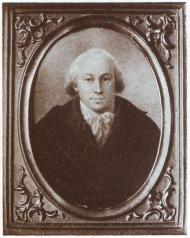
Aleksander Petrovitj Jermolov (ryska: Александр Петрович Ермолов), född 1754, död 1834, var en rysk general och älskare till Katarina den stora.
Jermolov presenterades för Katarina av Potemkin, utprovades av Anna Protasova och ersatte 1785 Aleksander Lanskoj som generaladjutant och älskare. Jermolov anslöt sig till Potemkins fiender och avsattes därför från sin ställning.
続きを読む...Catherine II of Russia
イヴァン・リムスキー=コルサコフ

Iwan Nikołajewicz Rimskij-Korsakow (ros. Иван Николаевич Римский-Корсаков, ur. 13 stycznia?/24 stycznia 1754 w Moskwie, zm. 4 lutego?/16 lutego 1831 w Petersburgu) – generał major Armii Imperium Rosyjskiego, fligeladiutant, szambelan i faworyt Katarzyny II, w 1779 roku oddalony od dworu.
W 1778 roku odznaczony Orderem Orła Białego.
続きを読む...Catherine II of Russia
Alexander Dmitriev-Mamonov
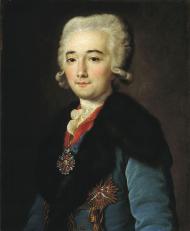
Comte Alexandre Matveïevitch Dmitriev-Mamonov (en russe : Александр Матвеевич Дмитриев-Мамонов), né le ; mort le , enseveli dans le monastère Donskoï) fut le favori de Catherine II de Russie de 1786 à 1789.
続きを読む...Catherine II of Russia
Alexander Lanskoy

Conte Aleksandr Dmitrievič Lanskoj (in russo Александр Дмитриевич Ланской?; Tallinn, 10 agosto 1758 – San Pietroburgo, 11 dicembre 1784) è stato un militare russo.
続きを読む...Catherine II of Russia
Sergei Saltykov
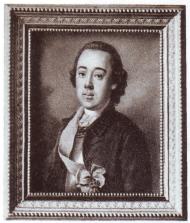
Le comte Sergei Vasilievich Saltykov (en russe : Сергей Васильевич Салтыков), né en 1722, et mort le , est un officier et diplomate russe qui fut le premier favori de l'impératrice Catherine II quand elle n'était encore que grande-duchesse.
続きを読む...Catherine II of Russia
Pyotr Zavadovsky
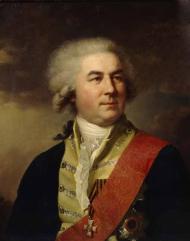
Pjotr Wassiljewitsch Sawadowski (russisch Пётр Васильевич Завадовский; * 10. Januarjul. / 21. Januar 1739greg. in Krasnowitschi, Ujesd Starodub, Russisches Kaiserreich; † 10. Januarjul. / 22. Januar 1812greg. in St. Petersburg, ebenda) war ein kaiserlich-russischer Offizier und Staatsmann ukrainischer Abstammung.
続きを読む...Catherine II of Russia
シメオン・ゾーリッチ

Siemion Gawriłowicz Zoricz (ur. w 1745, zm. w 1799) – generał lejtnant Imperium Rosyjskiego od 1797 roku, adiutant Grigorija Potiomkina, faworyt Katarzyny II w latach 1777–1778, kawaler maltański.
W 1778 roku odznaczony Orderem Orła Białego, odznaczony Orderem św. Jerzego w 1775 roku, kawaler Orderu Świętego Stanisława w 1777 roku, odznaczony szwedzkim Orderem Miecza.
続きを読む...Catherine II of Russia
アレクサンドル・ヴァシーリチコフ
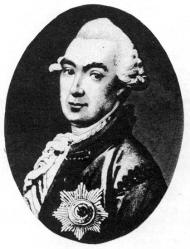
Alexander Semyonovich Vasilchikov (Russian: Александр Семёнович Васильчиков, tr. Aleksandr Semënovič Vasil'čikov; 1746–1813) was a Russian aristocrat who became the lover of Catherine the Great from 1772 to 1774.
Vasilchikov was an ensign in the Chevalier Guard Regiment when he was noted by Catherine and was appointed gentleman of the bedchamber on 1 August 1772. When Catherine's then-lover Grigory Grigoryevich Orlov left court, Catherine was informed about his adultery, and 12 August, Vasilchikov was made general aide-de-camp and lover of Catherine. Vasilchikov was expected to be available to attend on her at all times, and was not allowed to leave the palace without permission.
The relationship was short-lived. Catherine found Vasilchikov's gentleness cloying, saying "His tenderness made me weep." When Vasilchikov was away on a journey, sent by the empress, Grigory Potemkin replaced him as her lover. She wrote to her friend Friedrich Melchior, Baron von Grimm about Vasilchikov's dismissal: "Why do you reproach me because I dismiss a well-meaning but extremely boring bourgeois in favour of one of the greatest, the most comical and amusing, characters of this iron century?"
Vasilchikov later complained that he felt like a hired gigolo: "I was nothing more to her than a kind of male cocotte and I was treated as such. If I made a request for myself or anyone else, she did not reply, but the next day I found a bank-note for several thousand rubles in my pocket. She never condescended to discuss with me any matters that lay close to my heart."
Catherine characteristically rewarded her former lover richly. Vasilchikov was given a pension of twenty thousand rubles and valuable properties. He lived the rest of his life in Moscow. He never married. He built a notable collection of Western European paintings and sculptures, including a "Self Portrait" by Velasquez and works by Philips Wouwerman and Andries Botha.
続きを読む...Catherine II of Russia
Platon Zubov

Prince Platon Alexandrovich Zubov (Russian: Платон Александрович Зубов; November 26 [O.S. November 15] 1767 – April 19 [O.S. April 7] 1822) was the last of Catherine the Great's favourites and the most powerful man in the Russian Empire during the last years of her reign.
続きを読む...Catherine II of Russia
Gregory Potyomkin
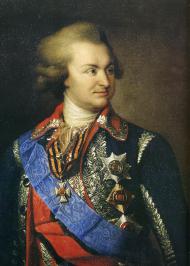
Prince Grigory Aleksandrovich Potemkin-Tauricheski (11 October [O.S. 30 September] 1739 – 16 October [O.S. 5 October] 1791) was a Russian military leader, statesman, nobleman, and favourite of Catherine the Great. He died during negotiations over the Treaty of Iași, which ended a war with the Ottoman Empire that he had overseen.
Potemkin was born into a family of middle-income landowners of Russian nobility. He first attracted Catherine's favor for helping in her 1762 coup, then distinguished himself as a military commander in the Russo-Turkish War (1768–1774). He became Catherine's lover, favorite and possibly her consort. After their passion cooled, he remained her lifelong friend and favored statesman. Catherine obtained for him the title of Prince of the Holy Roman Empire and gave him the title of Prince of the Russian Empire among many others; he was both a Grand Admiral and the head of all of Russia's land and irregular forces. Potemkin's achievements include the peaceful annexation of the Crimea (1783) and the successful second Russo-Turkish War (1787–1792), during which the armed forces under his command besieged Ochakov.
In 1775, Potemkin became the governor-general of Russia's new southern provinces. An absolute ruler, he worked to colonize the wild steppes, controversially dealing firmly with the Cossacks who lived there. He founded the towns of Kherson, Nikolayev, Sevastopol, and Yekaterinoslav. Ports in the region became bases for his new Black Sea Fleet.
His rule in the south is associated with the (probably mythical) "Potemkin village", a ruse involving the construction of painted façades to mimic real villages, full of happy, well-fed people, for visiting officials to see. Potemkin was known for his love of women, gambling, and material wealth. He oversaw the construction of many historically significant buildings, including the Tauride Palace in Saint Petersburg.
続きを読む...Catherine II of Russia
グリゴリー・グリゴリエヴィチ・オルロフ
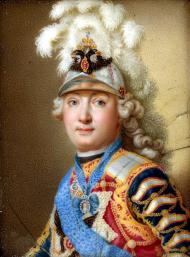
Prince Grigory Grigoryevich Orlov (Russian: Григорий Григорьевич Орлов; 17 October 1734 – 24 April 1783) was a Russian general and patron of arts who was Prince of the Holy Roman Empire (1772) and a favourite of Empress Catherine the Great. He was a leader of the 1762 coup which overthrew Catherine's husband Peter III and installed Catherine as reigning empress. For some years he was virtually co-ruler with her, but his repeated infidelities and the enmity of Catherine's other advisers led to his fall from power.
He patronised M. V. Lomonosov, D. I. Fonvisin, V. I. Bazhenov and gave them financial support. Honorary member of the Imperial Academy of Arts (since 1765). He collected paintings (including Rembrandt, P. P. Rubens, Titian), sculpture, Chinese, Japanese and Russian porcelain, hunting weapons, etc. (Orlov's collection has been preserved almost completely; it is now in the State Museum-Reserve "Gatchina" of the eponymous city). A large landowner, Orlov commissioned the construction of the Great Gatchina Palace.
続きを読む...Catherine II of Russia
Stanisław August Poniatowski

スタニスワフ・アウグスト・ポニャトフスキ(Stanisław August Poniatowski, 1732年1月17日 - 1798年2月12日)は、ポーランド・リトアニア共和国の最後の国王(在位:1764年 - 1795年)。スタニスワフ2世アウグスト(ポーランド語: Stanisław II August)とも呼ばれる。
続きを読む...